ai, shoemakers and the present
engineers and shoemakers are more common than most think

do you remember the old painters who used to be present in basically every village and town, and who had a bustling business? and the main draw of their business was designing and drawing these very stylized, beautiful-looking signboards, or drawing some sort of art for an exhibition that was supposed to happen in your village or in your town. and they were all the rage. more than that, they were a necessity.
similarly, i’m sure there used to be these very specialized shoemakers in villages. these people who were immensely, immensely, immensely talented, and who would spend hours and hours on one piece, on one pair of shoes, and when they were done, it was beautiful. it was massive, and it was incredibly detailed, polished, engineered in such a way that it was honestly awe-inspiring, the way they had made it.
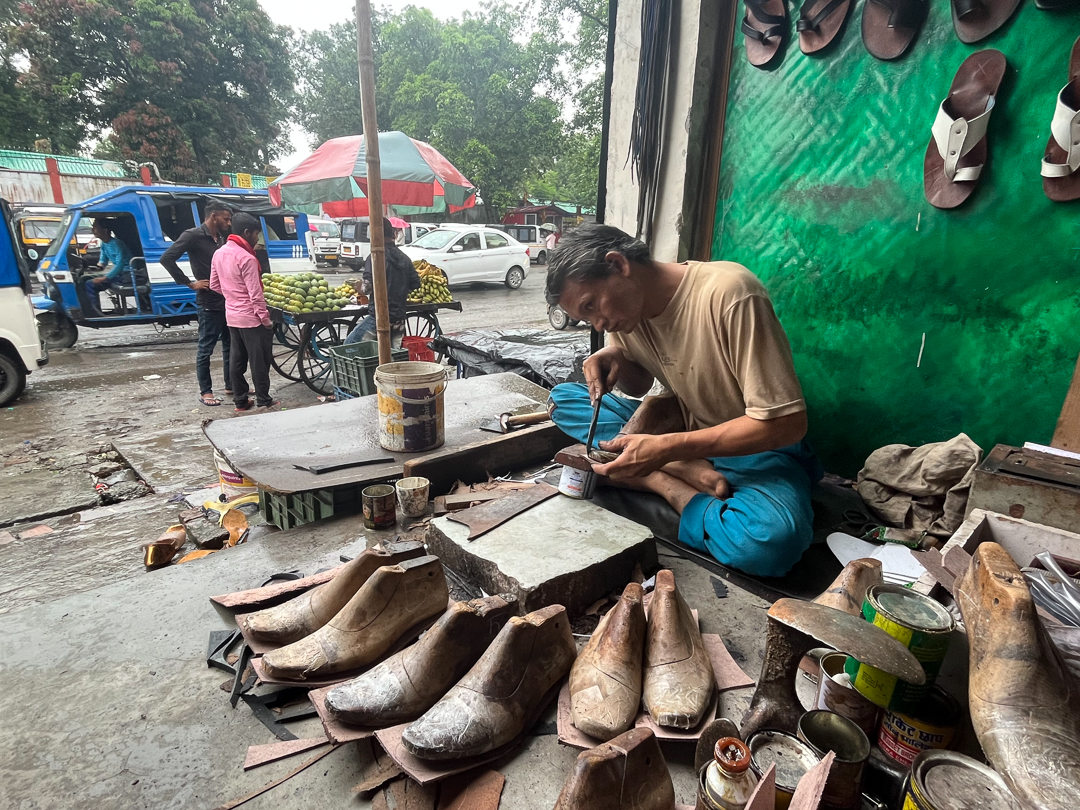
and this was the norm. it was tough to imagine a life where they wouldn’t exist within us, or amongst us in any way. it was really tough to imagine something like that.
and yet, if you really think about it today, they are basically… gone. that doesn’t exist now. that has ceased to exist.
the painter who used to have a quite, quite decent-sized shop in my village is now gone. he doesn’t have a shop anymore. his shop closed long ago. and the shoemaker near my house, who used to make custom shoes, is also gone.
and the reason i say this is not to say that their work is now obsolete in a way that it wasn’t before. rather, i think there are still people who get signs made manually, and who still really admire and pay a good amount of money for these highly specialized, beautiful, beautiful-looking signboards.
and there are still people who really obsess over these fancy shoes and these beautifully, immaculately designed pieces of craftsmanship. and the shoemakers also definitely still do exist.
and i think the question i would like to leave you on is this: all of this still exists, and of course it is also appreciated by most people. if you point it out to someone and say, “oh, okay, this is how my custom board was made. this is how my shoes look,” when you do say something like that, it’s bound to get a lot of applause.
but if you look down at your feet, what shoes are you wearing right now?
definitely not the ones that the shoemaker made.
or if you look at the signboard of your business, your office, your university, it’s highly likely that it’s a digital graphic that has been printed out or made in some other way. maybe it’s a neon sign, whatever else it might be.
but it’s not the craftsmanship or the artists who were once so prevalent that, at one point, it was tough to imagine living without them.
the reason i say all of this is to really draw a parallel to something that has been causing quite some dread in me, quite some terror in me, and that is artificial intelligence, ai.
ai is now more prevalent than ever, and i think it has reached a critical point, or rather crossed a critical point, where you can’t ignore it as a fad anymore. it’s not just glorious autocomplete, as some people would want to believe. it’s much more than that.
it crossed that threshold a long time ago, and with every subsequent release, i think it moves further and further beyond it.
what does ai now mean for technology, and more specifically, coding?
i think for the last decade or so, and probably even more than that, software engineering was the premium job. that’s what you got into when you wanted to make big bucks. this has been a trend that has just kept rising and rising. you see all these insane amounts being paid to engineers, and the demand, the demand was absolutely bonkers.

and i think the demand is still bonkers. it is still persisting in a lot of places where software engineers are highly valued, because in this ever-so-increasingly digital world, the only way to get anything done was through software engineers.
and these were people who would spend years and years and years mastering a specific niche.
there were some incredibly talented front-end designers, front-end developers, rather, who could conjure up these beautiful-looking masterpieces from thin air. and they knew all about the frameworks, all these little niche tricks, all these peculiarities that you only really understand after spending years working with them.
similarly, there were these systems engineers who knew every flag that there was to know, and what toggling one particular flag did to something else. there were these incredible game developers, and incredible people doing numerous other things.
i can just go on and on.
and if you’re in the technology sector, you know that every field has so many more subgenres and niches within it, and each of those niches has people who have spent an absurd amount of time becoming incredibly, incredibly good at that one particular thing.
there is this thing that’s happening now, though, where these niches and these genres and these subfields and technologies that people spend so much fucking time on, so much of their fucking energy working on, where they have a life’s worth of repertoire and knowledge, this massive, massive repository of everything they have gathered, everything they have learned, everything that they know.
it’s becoming increasingly commodified.
and i think i’m not exactly saying something new when i say coding would become commodified, because coding definitely is becoming commodified. i think a lot of people agree on that, especially with the advent of models that are so cheap and can generate such good, high-quality code on the fly.
that’s not really a new thing to say anymore.
at the same time, i think it’s worth examining something else.
i think the way to think that really put some dread in me, while also helping me gain some perspective on all of it, was this: coding, and people who code by hand, these incredibly skilled, talented, beautiful people, they’ll continue to exist.
they will continue to exist, and they’ll continue to make and churn out this beautiful human-written code.
but, as has happened in the past, it won’t be a thing that everyone needs.
it won’t be the thing that’s gluing the modern world and its infrastructure together and, hence, requiring a fleet of engineers everywhere, from the lowest level to the highest.
that will cease to exist.
and similarly, what rapid manufacturing capabilities did to shoes, or really to any appliance or clothes that we are wearing right now, the same thing is going to happen with code.
let’s think about clothes for a while.
there are these shops that i often visit. there’s this one particular shop in nagpur where i have bought these intricate hand-woven kurtas, and they’re beautiful, and they’re so comfortable to wear.
but that’s a one-off seasonal, not even seasonal, a one-off, rare purchase from me.
that’s not something i do regularly. that’s not something i wear on myself regularly.
because there is this mass industry that can churn out clothes like nothing else. there is this incredibly, devastatingly unfair industry, which is also fast fashion, where trends change by the weeks and clothes end up in landfills all the time.
and that’s all a direct result of the fact that it got commodified.
and i think i would like to stay with this analogy of ending up in the landfill, because as i perceive the landscape around me every day, the cost and the effort required to make software has gone down dramatically.
things that would have taken people months and months and months of work can now be churned out in a few hours with a capable model.
so now, this modern landfill is github, or any public source control hosting provider, because people make projects in a few days, including me, of course, a lot of times, and they end up in these repositories.
and it’s also very much evident by the rate that github servers keep failing because the amount of code being pushed is unlike anything github has ever, ever seen before. every single day, there is an immense wealth of code being pushed to github, and they’re facing the brunt of it through the stressed servers that they have.
but more than that, i think there’s something really telling here:
if everyone is developing, who really is the consumer anymore?
if everyone can spin up whatever version of the code that they want, who is really using someone else’s code?
and i don’t remember, except for a very few instances in the last year or so, when i really went to someone’s github profile and looked through their repositories and was really, really inspired by it, and saw some very exciting stuff in it.
because now, whatever comes to my fancy, i could, with the help of these ai tools, develop it fairly quickly.
there is still effort required from my end. there is still some learning required from my end, depending on whatever it is that i’m developing.
for example, i recently developed period, this period tracker for my girlfriend, because she really complained about the way period trackers would work, how they would be predatory, and so on and so forth.
so i sat down. i learned a bit about periods. i learned about the different menstrual cycles and how they all behave with each other. it was very illuminating in a lot of senses.
but at the same time, the actual cost, in terms of the work that would have otherwise taken me several, several months, i was able to bring down dramatically.
i was able to get it done in several weeks.
so, again, it really begs the question: what is code going to look like?
and i think the best way to think about code is that code won’t be this very tangible, solid thing that you interact with. your services and your apps won’t necessarily be these solid blobs that exist on the internet or on your phone, which load up and spin up these very deterministic behaviors.
rather, i think it’ll be something more fluid.
and i don’t mean that it’ll all be hallucinated by an llm, or that there’ll be some mega matrix rapidly generating slop all the time and nothing is deterministic anymore.
rather, i think the app or the website or the service that you use or rely on a lot will do maneuvers for you. i think it’ll shift itself in real time according to whatever it is that you need.
ai, as with every other industry, goes through this tick-tock phase.
and what i mean by tick and tock is that every tick is a massive advancement. there’s a big breakthrough. and the tock is where that big breakthrough is made more accessible. it is turned into something more streamlined, something cheaper, something much more available to the general public.
and i think this tick-tock will lead us to a place where even the base, free, cheap models become increasingly and increasingly capable.
and when it gets to a point where some critical threshold is passed, where models with the capabilities of something such as gpt astra or the new opus 5.5, which are relatively expensive to run, become cheap enough, i think something really changes.
and some people would argue, including me, that for the capabilities these models already provide right now, they are still priced pretty cheaply, especially when you are accessing them through subscription plans subsidized by these massive companies.
but once that capability becomes cheap enough, i think there’ll be a seismic shift in the way that we interact with our digital world.
and that seismic shift would be scary.
that seismic shift would send a lot of people into a state of paranoia, a state of excitement, and a state of anxiety, all at the same time.
because these tools would be akin to creating your own god.
it would be something that bends and bends to your will, and does that without hallucinations.
and i think a lot of jobs would be eaten, as we are already seeing with the layoffs.
and as much as i want these big fucking overlords, these tech overlords, these billion-dollar soulless corporations, to be wrong and fall on their faces for trusting a computer over humans, i don’t think that’s practical.
i don’t think that’s practical at all.
i think they are thinking in the right direction, and that’s scary because i am also an engineer.
there will still be a need for engineers. there’ll still be some people interfacing with these programs and getting it all into place. but i think the amount of people required to interface with these systems would be minuscule compared to the fleet that we have right now.
i lead a team in my company right now.
the team that i lead is made up of incredibly capable people. smart people, funny people, talented people. and at the same time, there have been days where i have been able to get the same outputs, and sometimes better outputs, in a few days that me and my team would have taken months to make.
so i don’t share these thoughts from some vantage point above everyone else, because i’m not at some vantage point.

i’m in the crowd with everyone else.
i exist within this crowd which is being swept away by these big waves, and i think it’ll be scary, and i think it’ll be exciting, and i think it’ll be unlike anything else that we have seen.
and again, i don’t mean to sound like these tech overlords who want this to be a thing that they look forward to because they want to cut down their operating costs by as much as possible.
i don’t want to mimic their talking points.
but sadly, i think that’s where we are headed as a society.
and i say all this, and i think it’s also worth pointing out: what would humans be excelling at that ai, llms, and all these scary big-name technologies won’t?
and i think the answer that rings even truer than ever before is art.
ai cannot make art.
not because it’s not capable, but rather because it’s not human.
the reason that i say that is because a lot of the reason people engage with art is precisely because it’s human.
no matter what art it might be, whether it’s lowbrow or highbrow, art is made by humans for humans. and art is something that exists without a good reason for it existing.
everything else can be pinned down to some basic need that humans have. every craft can be boiled down to an extension of a human need.
a great chef is a craftsman. he’s not an artist.
a great chef can make incredibly beautiful food and be incredible at it and make something that will make you lose your mind, but at the same time, it is a craft. it is made because it’s an extension of a basic human need.
at the same time, art has no reason to exist.
the fact that we even make art is as absurd as anything else, because there is no innate reason for art to exist. there is no basic human need it serves, and yet, even from the first very primal humans, we have always been lovers of art.
we have been telling folktales and stories, stories of these mythical creatures, and making up these beautiful worlds for the sake of making up these beautiful worlds.
and i think that will continue to exist.
and we see this shift in the zeitgeist because we see these out-of-nowhere indie films doing incredibly well and connecting with people.
we saw a film called the odyssey, which was a big-name release, but yet it was based on this incredibly old work by homer, and its adaptation became one of the biggest things that people looked forward to.
we saw that with obsession, an indie flick which swept the world away.
we saw that with niu lai, where the animation was very poor by modern standards, and yet people went in crowds and crowds to watch it because it was entirely human.
it was a film made by a mother and her son over five years, with the two of them putting an absurd amount of themselves into making it.
and that’s what art does.
this essay has swerved from ai landscape analysis to examining code paranoia and to praising art. but that’s just who i am. i won’t stop building cool shit and cool software just because it’s easier to do so, i won’t sit and cry over potential loss of the software engineering age because i could have an apple farm at home i can get into, i can’t rest because i got to make some more art.
thank you for reading all of this.